Quantum Encryption Technology for Highly Secure Government Communications
Katharina Kloiber | 11.04.2023
AIT and BMK successfully demonstrate tap-proof communication system as an important basis for increased data sovereignty
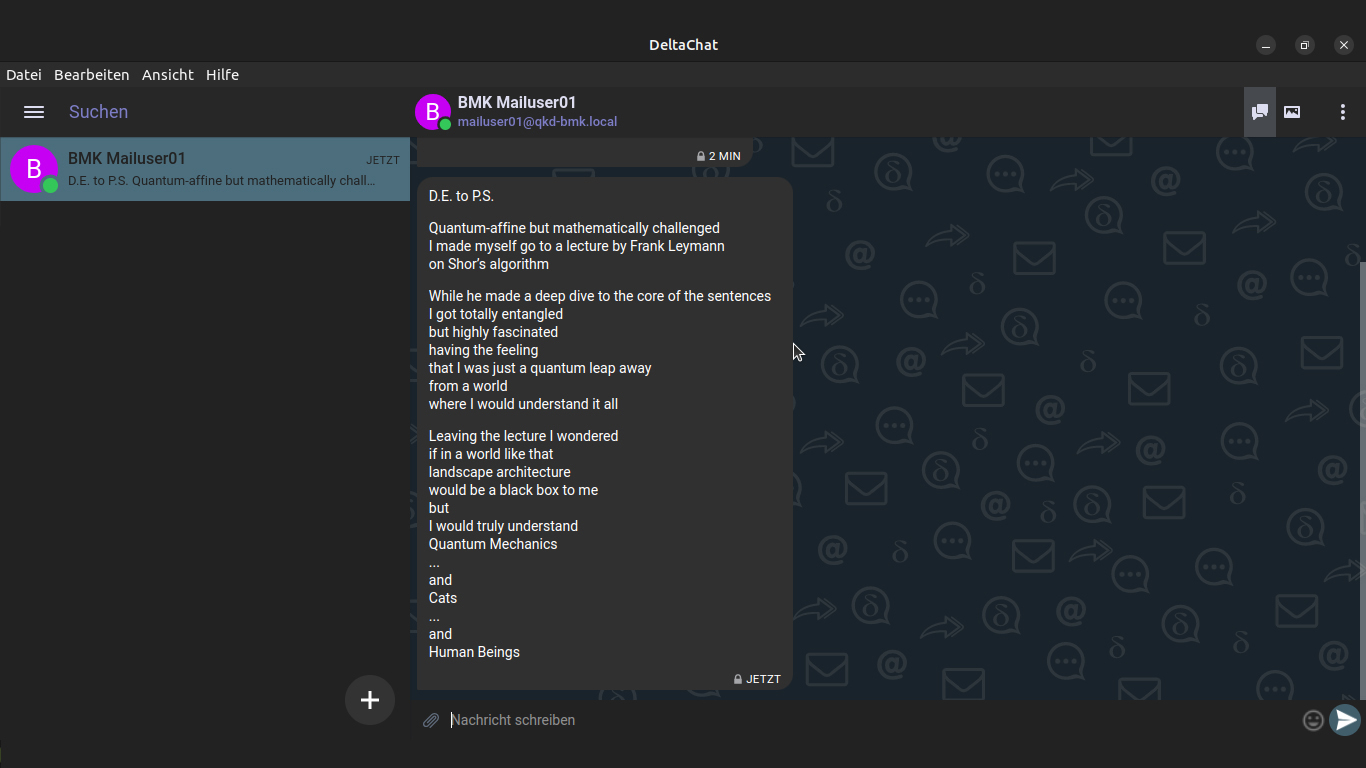
Quantum-encrypted chat message from an AIT account with message from the BMK
(c) AIT/BMK
On February 23, 2023, the AIT Austrian Institute of Technology and its consortium partner X-Net Services GmbH, together with the Federal Ministry for Climate Protection, Environment, Energy, Mobility, Innovation, and Technology (BMK) as early adopters, demonstrated the future of highly secure government communications based on the world's most advanced communications and encryption technology. As part of a live demonstration, messages were exchanged via a chat between the AIT and the BMK.
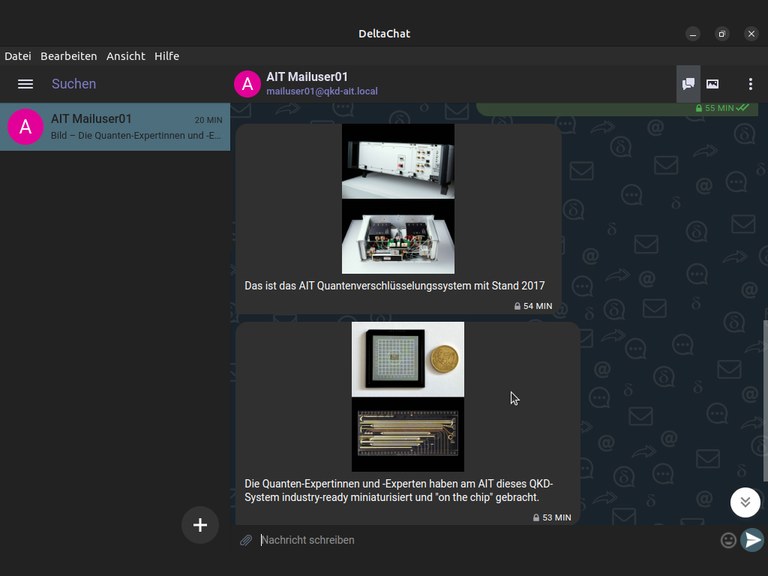
Demonstration as part of the QKD4GOV project
Helmut Leopold (AIT) transmitted quantum-encrypted images with a comparison of the rapid development progress of AIT quantum encryption technology from 2017 to today
(c) AIT/BMK
The data communication was encrypted using quantum-secure cryptography. This technology enables the generation of a very large number of different, highly secure and independent keys, thereby achieving significantly higher eavesdropping security for both end-to-end secure data communication and data processing. Against the backdrop of quantum computers being used in the future, this is an important technology for the future in order to ensure data sovereignty in Austria and Europe in the long term. The development activities relating to this communication infrastructure, which was set up for testing purposes between the two aforementioned players, as well as the technology evaluation of quantum encryption in conjunction with commercial systems, were carried out in the project “QKD4GOV - Securing government data using quantum-secure cryptography.” The project addresses the transmission of confidential information between government agencies in various application scenarios and is funded by the BMF's KIRAS security research funding program.
Désirée Ehlers, Federal Ministry for Climate Protection, Environment, Energy, Mobility, Innovation, and Technology (BMK), Dept. III/5 – Key Technologies for Industrial Innovation: "Where Austrian cutting-edge research leads to application-oriented developments, an innovative and sustainable cooperation ecosystem involving research, industry, and administration is needed. That is why the BMK is actively involved as an associate partner in innovative quantum technology projects for the secure and profitable application of Austrian know-how, making a forward-looking contribution to Austria's goal of data and technology sovereignty."
Helmut Leopold, Head of AIT Center for Digital Safety & Security: “AIT has successfully established itself as an important source of expertise and technology in the EU for the future highly secure European communications network. Cooperation with the public sector is a very important prerequisite for the development of an economic ecosystem and thus for the international establishment of high-tech Made in Austria.”
Nikolaus Dürk, founder and managing director of X-Net Services GmbH: “It's only a matter of time before conventional encryption is no longer sufficient to adequately secure sensitive data and data communication. We are working to ensure that new technologies such as quantum cryptography are not only usable in the laboratory, but also give rise to real-world applications that set a European standard.”
The decisive factor for this high-tech success in the field of digitalisation with cutting-edge technology from Austria was the long-term public funding of basic research. Based on the resulting groundbreaking research work by Professor Anton Zeilinger, AIT focused very early on the industrialisation of scientific findings in the field of quantum communication. As a result, Austria's largest application-oriented research institution is now internationally recognised as a specialist in terrestrial and satellite-based quantum cryptography. AIT is a driving force and coordinator of major European research projects, such as the highly competitive European “Quantum Flagship” program, which aims to develop quantum technologies for the mass market. This is not least because the miniaturisation of the technology is an essential prerequisite for broad industrial applicability, which is why this development step has been a central focus of the work of AIT quantum researchers to date.
Important contribution to the industrialisation of highly secure quantum encryption
Now that this milestone has been reached, with the optical setups required for quantum encryption fully functional on 2x4 mm chips, making the technology ready for industrial use, field trials are now underway with various European players from industry, industry, and the public sector as part of the European EuroQCI (European Quantum Communication Infrastructure) initiative. In this context, AIT is coordinating the QCI-CAT project, which is funded by the EU and the national “Fonds Zukunft Österreich” (Fund for the Future of Austria) and is driving forward the development of a quantum communication infrastructure for highly secure government applications in the EU and implementing specific applications in Austria. Furthermore, AIT is playing a leading role in the PETRUS project led by Deutsche Telekom, which coordinates the development of the EU-wide highly secure EuroQCI communication infrastructure. Over the next ten years, a European cyber shield based on a quantum communication infrastructure consisting of terrestrial and satellite-based solutions is to be established. These EU initiatives, with the strong support of Austrian know-how and technologies, are an important contribution to ensuring the EU's data sovereignty in a global context in the long term.
Austrian quantum technologies in space
AIT technologies are also on board in the current EU project to establish a European satellite communications network for encrypted Internet called IRIS2 (Infrastructure for Resilience, Interconnectivity and Security by Satellite), which complements the fiber-optic-based terrestrial EuroQCI networks: Up to 170 satellites are to be launched into Earth orbit in the coming years. The primary goal is to strengthen autonomy in space and thereby create alternatives to initiatives such as Starlink, which are essential for disaster control and relief operations, for example. In addition, regions with inadequate infrastructure, such as Africa and the Arctic, are to be connected. To ensure the security of data traffic, quantum encryption methods are also being integrated here. More than six billion euros are being invested in a public-private partnership model.